Boost Your App
Please fill in the form below and we'll call you back in no time.
Your request has been received! We'll be in touch shortly
Oops! Something went wrong while submitting the form.

What is a CR, and How Does It Impact Your App's Performance?

App Store Optimization
CRO
Mar 18, 2025

In mobile marketing, the conversion rate (also known as CR) is a key metric for assessing an app's product performance and marketing strategy. A higher CR indicates a more successful promotion.

In this article, I will explain how to determine the CR and provide average conversion rates for different categories of apps in the App Store and Google Play.

Even more insights from ASO & UA pros in ASO Busters on Discord!

Why should you measure mobile app conversion rates?

CR is the percentage of users or visitors to a mobile app store page who complete a targeted action (conversion).

These metrics vary between the App Store and Google Play and also depend on the app's category.

Tracking conversions to the desired action helps evaluate an app's effectiveness or investment and provides valuable insights for your promotion strategy.

The main reasons to focus on CR:

  1. User engagement. A high CR typically indicates that the design and user experience align with visitors' expectations, leading to longer app usage and improved user retention.
  2. Monetization. The higher the conversion rate, the more revenue an app will generate. This is especially true for apps and games with in-app purchases, as well as those that rely on subscriptions as a monetization tool.
  3. A/B testing. CR is essential for evaluating A/B testing results. By identifying the most effective tested elements, you can implement them for better performance.
  4. Resource allocation and cost-effectiveness. In user acquisition, ROI (return on investment) plays a key role and increases as CR improves.
  5. ASO optimization. An engaging app page tailored to your target audience boosts organic installs and page visits. Additionally, conversion rate impacts ranking, as the App Store and Google Play algorithms favor apps that attract and retain users.

Conversion rate metrics on the App Store and Google Play

The main ones include:

  1. Install Rate (Impression-to-install). This is the percentage of users who installed an app directly from search results or featured selections in the Today, Games, and Apps tabs without visiting its App Store page. This metric is not applicable to Google Play.
  2. Page view-to-install. In the context of mobile applications, this ratio represents the percentage of visitors who installed the application after visiting its app store page. This indicator is relevant only for Google Play, as the App Store includes installs from search in the total count but does not separate them from page views. Therefore, for the App Store, referring to the page views-to-install ratio as a conversion rate is inaccurate, as many users install the app without visiting its page.

For both stores, you can identify auxiliary metrics:

  1. In-app Conversion Rate (Install-to-purchase). Indicates the percentage of users who completed a targeted action after installing the app, such as subscribing or making an in-app purchase.
  2. Advertising Conversion Rate. Allows you to estimate the percentage of users who clicked on an ad - click-through-rate, and in Apple Search Ads - tap-through-rate. It is calculated as the number of clicks or taps divided by the total number of ad impressions.

It also displays the percentage of users who saw the ad and performed the targeted action - installation (the ratio of app installs to the total number of ad impressions).

  1. Average Time on Page. Indicates the average time users spend on the app page before installing it.
  2. App Page Scroll Depth. Indicates the percentage of content on the mobile app store page that visitors view.

How to determine app store conversion rate?

App Store 

CR in App Store Connect helps you determine how often users install your app after seeing it in the App Store. This metric is calculated as the ratio of Total Downloads to Unique Impressions.

Note: The Total Downloads metric includes all app installs, including repeat downloads and pre-orders before the official release.

Note 2: Unique Impressions include all unique impressions from the Today, Games, Apps, or Search tabs in the App Store, as well as views of your product page. 

In the App Store, conversion data can be found in the Analytics section, after selecting the desired app. The Overview, Acquisition, and Metrics tabs provide various options for visualizing data:

Conversion graph on the Overview tab
Conversion graph in the Acquisition tab
Conversion graph in the Benchmarks tab. You can customize it by selecting specific time periods, filters (device, iOS version, region, etc.), and data display options (by day, week, or month).

Google Play

Unlike the App Store, Google Play calculates conversion as the ratio of Store Listing Acquisitions to Store Listing Visitors.

Store Listing Acquisitions - the total number of users who visited the app store listing page and installed it without previously downloading it on other devices. Store Listing Visitors - the number of visitors who visited the app store listing page and installed it for the first time. 

Since the number of clicks to the app's store listing page is much lower than its impressions in the store, the CR on Google Play will be significantly higher than on iOS.

In Google Play, conversion data is located in the Grow → Store performance → Listing conversion analysis section:

In addition to graphs showing page visits and installs over time, this section includes a conversion rate dynamics chart, which also compares your app’s performance with competitors in the same category (Peers' Median and Peers' Range):

Conversion dynamics in Google Play

Similar to the App Store, you can apply various filters when creating a chart: by country, traffic source, device language, search term, etc.

Average Conversion Rates by App Category in the App Store

Average Conversion Rates by App Category in the App Store

As of September 2024, the average conversion rate in the App Store from search was 6.6% in the United States. In Ukraine, it is higher - 9.1%.

Keep in mind that conversion rates vary by category and traffic source. Consider these factors when selecting a benchmark for your app.
Points scored
Source: appfollow.io

In the US, the highest conversion rates are in the Travel (11.8%), Food & Drink (10.8%), and Navigation (10.5%) categories. The lowest CR is in the Games category - 1.9%. Depending on the genre of the game, this average can vary from 1.4% (Casino and Racing) to 4.8% (Trivia).

Points scored
Source: appfollow.io

It is worth noting that conversion rate is not a static metric and can fluctuate over time. In 2024, the U.S. categories with the most variable CR include:

  • Food & Drink saw a sharp increase in March;
  • Graphics & Design - growth since the second quarter;
  • Navigation and Travel started to grow in Q2, peaking in July, the holiday season;
  • Shopping - a sharp increase in CR in July, which may be due to off-season sales;
  • Sports - a sharp increase in CR in March, followed by a further decline;
  • Weather - gradual growth throughout the year.
Points scored
Source: appfollow.io

Average conversion rates vary by country and by category. In Ukraine, the highest CR is seen in the Reference (25.8%), Navigation (17.7%), and Travel (12.7%) categories.

Points scored
Source: appfollow.io

Similar to the U.S., games have the lowest CR in Ukraine at 2.7%. The lowest conversion rate is in the Card genre (1.9%), and the highest is in the Role Playing genre (7.1%).

Points scored
Source: appfollow.io

In 2024, the most significant fluctuations in CR in Ukraine were observed in the following categories:

  • Developer Tools - growth peaks in February and June;
  • Music saw a significant decline after the Eurovision Song Contest;
  • in the Navigation and Travel categories, unlike in the US, the conversion rate decreased in the summer months;
  • Reference - a sharp increase in February with further growth;
  • Shopping - CR growth during off-season sales;
  • Sports - there was an increase in conversion in May (before the UEFA Champions League final) and in August (the Olympic Games in Paris).
Points scored
Source: appfollow.io

Average Conversion Rates by App Category on Google Play

Average Conversion Rates by App Category on Google Play

The average Page view-to-install rate in September 2024 was 46.2% in Ukraine and 47.4% in the US.

Points scored
Source Google Play Console

The highest average conversion rate in both Ukraine and the US is in the Travel & local category - 58.4% and 60.8%, respectively. In the US, the Food & drink category also has an average CR of over 60% (60.3%).

The categories with the lowest CR in Ukraine include Weather (35.7%), Personalization (37.9%) and Art & design (38.9%). In the US, these are Art & Design and Personalization (36.8%), Comics (37.5%).

Looking at the conversion rate in dynamics, the most dynamic categories in the US in 2024 include:
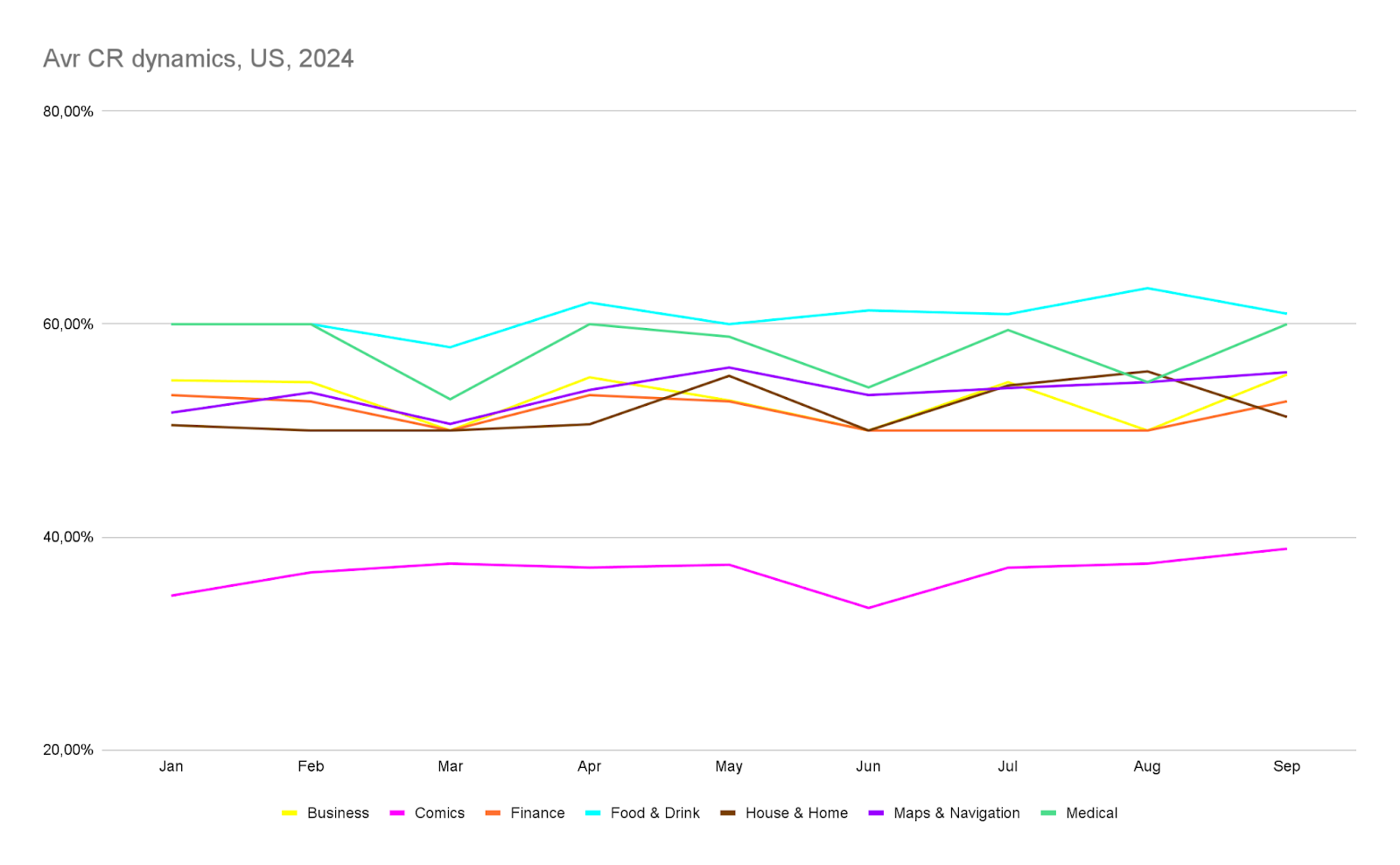
  • Business;
  • Comics;
  • Finance;
  • House & Home;
  • Medical;
  • Maps & Navigation and Food & Drink are also among the most fluctuating categories in terms of CR in the App Store.
Points scored
Source Google Play Console

In Ukraine, CR fluctuations are more noticeable than in the United States, reaching 10-12 percentage points in some categories, for example:

  • Travel & Local is also one of the most variable categories in terms of CR in the App Store;
  • Events;
  • Live television;
  • News & Magazines;
  • Parenting.

The fluctuation of CR in the Education and Video players & Editors categories is slightly less pronounced (7-9 points).

Points scored
Source Google Play Console

Traffic
Popularity
Keyword
1
385 585
99
instagram
2
325 480
98
whatsapp
3
201 485
95
telegram
4
177 737
94
facebook
5
119 067
91
tik tok
6
92 427
90
ifood
7
80 473
87
tinder
8
69 379
87
capcut
9
65 120
87
nubank
10
64 602
86
uber

Conclusion

  1. CR is a key performance indicator in mobile marketing, representing the percentage of users who complete a targeted action. Optimizing CR can drive more installs and increase the percentage of users who make a purchase or subscribe.
  2. Conversion rates are not fixed; they vary based on the app store (App Store vs. Google Play) and app category.
  3. CR is an important indicator when evaluating user engagement, A/B testing results, ASO optimization, resource allocation, and many other processes.
  4. CR is calculated differently across platforms: in the App Store, it is the ratio of installs to impressions, while in Google Play, it is the ratio of installs to app store listing page visitors.
  5. The average CR varies by country (market) and changes over time. For each product, the process of working on conversion will differ depending on the goals, niche, market situation, and user needs.

Home
Up